Florida roofs take a beating from the sun.
On a hot Tampa afternoon, your roof is absorbing direct sunlight for hours at a time, so it is natural to wonder what happens when you cover part of that roof with solar panels.
Do the panels trap more heat?
Or do they actually help keep the roof cooler?
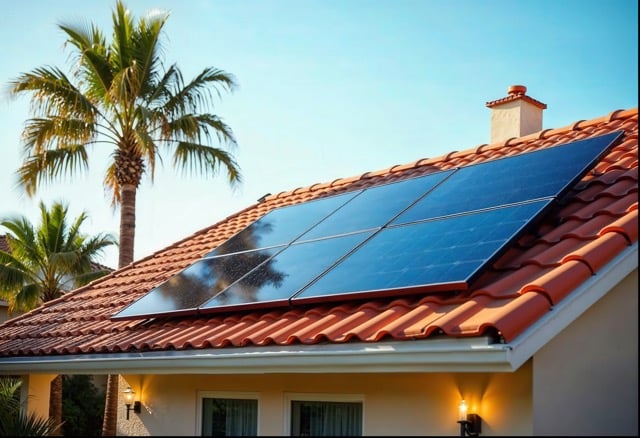
In many cases, rooftop solar panels can actually reduce the amount of direct heat reaching the roof beneath them by creating shade and allowing air to move between the panels and the roofing surface.
Here’s what is really happening.
Solar Panels Act Like Shade for Your Roof
The simplest way to think about it is this:
Solar panels sit between the sun and your roof.
Instead of sunlight hitting the roofing material directly, much of that solar energy hits the panels first. The panels use part of that energy to generate electricity, while the rest is released as heat.
Because the roof beneath the panels is shaded, it is not exposed to the same amount of direct solar radiation as an uncovered section of roof.
Research from the University of California, San Diego found that daytime ceiling temperatures beneath solar panel arrays were cooler than areas beneath exposed roofing. The researchers also found a measurable reduction in daytime heat transfer through the roof.
But Solar Panels Get Hot — So Why Doesn’t the Roof?
Solar panels absolutely get hot in direct sunlight.
However, most rooftop systems are not pressed directly against the roof.
They are mounted above it, leaving a small air gap between the panels and the roofing surface.
That gap matters.
Air can circulate underneath the panels and carry away some of the heat. UC San Diego researchers found that panels with more airflow underneath them provided a stronger cooling effect than panels installed closer to the roof surface.
So while the panels themselves may be hot, the roof underneath them can still be cooler than an area exposed directly to the sun.
Does This Mean Solar Panels Will Make Your Whole House Cooler?
Potentially, but it is important to keep expectations realistic.
Solar panels are not a replacement for insulation, ventilation, or air conditioning.
The amount of cooling benefit you notice inside your home will depend on several factors, including:
- How much of your roof is covered by solar panels
- Your roof material and color
- The amount of attic insulation
- Attic ventilation
- The size and layout of your home
- How much direct sunlight your roof receives
- How the panels are mounted
The biggest effect happens directly beneath the solar array.
A UC San Diego study found that the panels reduced daytime heat transfer through the roof and lowered ceiling temperatures beneath the array by as much as about 5°F during the study period.
That does not mean every home will see the same number, but it demonstrates that solar panels do not necessarily make a roof hotter simply because the panels themselves heat up.
Why This Matters in Florida
This effect is particularly interesting in places like Tampa, where homes experience long periods of strong sunlight and heavy air-conditioning use.
During the warmer months, reducing the amount of solar heat hitting the roof can reduce some of the heat entering the building.
At the same time, your solar panels are producing electricity that can help offset the power your home is using for air conditioning.
So the panels are working in two different ways during a sunny Florida afternoon:
They are producing electricity from sunlight while also shading the portion of the roof beneath them.
That does not eliminate your home’s cooling load, but it is a useful secondary benefit of rooftop solar.
What Happens at Night?
The effect changes after the sun goes down.
Without direct sunlight hitting the roof, there is no solar heat for the panels to block.
The panels can also slightly reduce how quickly heat escapes from the roof at night because they create another layer between the roof and the open sky.
Researchers at UC San Diego observed this effect as well: areas beneath the panels were somewhat warmer at night than exposed portions of the roof.
For homeowners in a warm climate like Florida, however, the daytime shading effect is usually the more relevant part of the conversation.
Will Solar Panels Damage My Roof From Heat?
Properly designed and installed solar panels should not damage a roof simply because they get hot.
Solar panels and mounting systems are designed for continuous outdoor exposure, including high temperatures and direct sunlight.
The bigger consideration is the condition of the roof before installation.
If your roof is approaching the end of its useful life, it may make sense to address that before adding solar. Removing and reinstalling panels later so the roof can be replaced adds extra work and cost.
A professional solar installer should inspect the roof and determine whether it is suitable for a solar installation before the project begins.
Does the Type of Roof Matter?
Yes.
Different roofing materials absorb and release heat differently.
Dark asphalt shingles, for example, can absorb a significant amount of solar heat, while lighter or reflective roofing materials tend to reflect more sunlight.
The amount of shading provided by solar panels can therefore have a different effect depending on the roof beneath them.
Roof pitch, orientation, ventilation, and the spacing between the panels and roof can also influence how much heat is transferred into the building.
What About Florida’s Hot Summer Temperatures?
Solar panels are designed to operate in hot climates, but high panel temperatures can slightly reduce their electrical efficiency.
That does not mean solar panels stop working when Florida gets hot.
They continue producing electricity throughout the summer, and long sunny days can still provide strong overall energy production.
The important distinction is that panel temperature and roof temperature are not the same thing.
A solar panel may be hotter than the surrounding air while the roof directly beneath it remains shaded and cooler than an exposed portion of roof.
So, Do Solar Panels Make Your Roof Hotter or Cooler?
In most properly installed rooftop systems, solar panels tend to keep the roof beneath them cooler during the day rather than making it hotter.
They shade the roof from direct sunlight, and the air gap between the panels and roofing allows some heat to dissipate before it reaches the structure below.
That cooling effect is not the primary reason homeowners install solar, and it will vary from one home to another.
But in a sunny climate like Florida, it is a nice additional benefit.
Your roof gets shade.
Your solar panels generate electricity.
And your home has one less section of roof absorbing direct Florida sunshine all afternoon.
If you are considering solar electricity for your Tampa-area home, Solar Solutions can evaluate your roof, energy usage, and solar exposure to help determine what type of system makes sense for your property.